Driving Test Ontario: Free G1 Knowledge Test Practice 3
- The test is based on questions taken from the MTO (Ontario) Driver’s Handbook.
- You will be asked about Safe and Responsible Driving and Traffic Signs and Lights.
- The test is a series of multiple choice questions.
Need the handbook?
Download the official Ontario Driver’s Handbook PDF for free.
Reminder: To obtain your Ontario G driver’s licence, you will need to pass a knowledge driving test.
G1 or G2 drivers with 9+ demerit points in 2 years face a suspension of:
60 days
30 days
1 year
15 days
In Ontario, if you are a Level 1 (G1) or Level 2 (G2) driver and accumulate 9 or more demerit points within a two-year period, your license will be suspended for 60 days. This penalty is designed to encourage safe driving and reduce traffic violations.
What does this sign indicate?
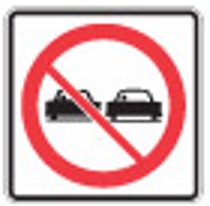
Right lane ends
Hidden intersection
Steep hill ahead
No passing
This regulatory sign indicates that passing or overtaking other vehicles is not allowed in this zone. It is typically posted in areas where visibility is limited or road conditions make overtaking unsafe, such as on curves, hills, or near intersections, to prevent accidents.
What does this sign indicate?
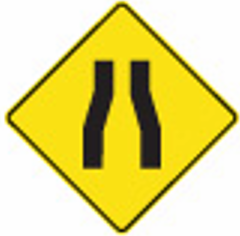
Divided highway ahead
One-way street
Hidden intersection
Pavement narrows
This warning sign alerts drivers that the road ahead will become narrower than the current lane. Drivers should slow down, stay centered in their lane, and be cautious of oncoming traffic or nearby vehicles to avoid sideswipes or loss of control on the narrowed roadway.
Are drivers responsible for their passengers buckling up?
Only if passengers are 5-16 years old
Only if passengers are over 16 years old
Only if passengers are in the first seat
Only if passengers are over 18 years old
In Ontario, drivers are legally responsible for ensuring that passengers aged 5 to 16 years are properly secured with seat belts or appropriate child car seats. This responsibility extends to all passengers within that age range, ensuring their safety in accordance with provincial regulations.
What happens if a G driver gets 15+ demerit points?
At the discretion of the Ministry
Auto suspension, 30 days from license receipt
Auto suspension, 60 days from license receipt
For 3 months
In Ontario, when a fully licensed (Class G) driver accumulates 15 or more demerit points, their driver's license is automatically suspended for 30 days. This suspension is mandatory and starts from the date the license is surrendered to the Ministry of Transportation.
Demerit points stay on your record for how long from offence date?
One year
Three yrs
Two yrs
Five years
In Ontario, demerit points remain on your driving record for two years from the date of the offence. This applies regardless of the date of conviction or payment, meaning the points will stay on your record for two years from when the offence actually occurred.
Always drive at a speed that lets you:
Stop within a safe distance
Stop within 60 meters
Stop within 90 meters
Stop within 150 meters
According to the MTO Driver’s Handbook in Ontario, drivers must always operate their vehicle at a speed that allows them to stop safely within the distance they can clearly see ahead, regardless of the time of day or weather conditions such as fog, rain, or snow.
When may you lend your driver’s license?
For identification purposes
To someone learning to drive
Never
Only in an emergency
In Ontario, it is illegal to lend your driver’s license to anyone for any reason. Your driver’s license is a personal legal document that proves you are authorized to drive. Lending it for any purpose, including learning or emergency use, is considered fraudulent and can lead to penalties.
What does this sign signify?
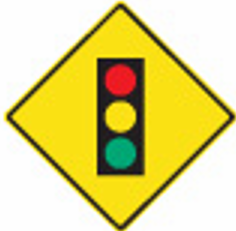
Traffic signal ahead
Stop sign ahead
Bump ahead
Railway crossing
This warning sign informs drivers that a traffic signal is approaching. Drivers should reduce speed and be alert for potential changes in light, preparing to stop if necessary. This helps maintain safe driving conditions and prevents last-minute braking near intersections with traffic lights.
What does this sign tell you?
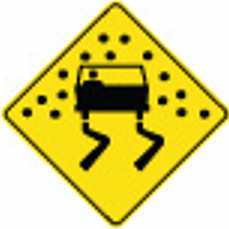
Slippery road when wet
Bumpy road ahead
Winding road ahead
No passing
This warning sign indicates that the road can become slippery when wet, often due to rain or snow. Drivers should reduce speed, increase following distance, and exercise caution to prevent losing control of their vehicle, especially on curves or in areas prone to water accumulation.
What does this sign tell you?
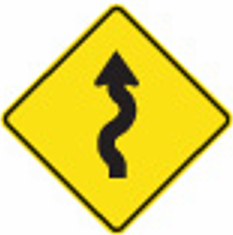
Hidden intersection
Winding road
Slippery when wet
Narrow road
This sign indicates a winding road ahead, meaning the road contains several curves or sharp bends. Drivers should reduce their speed, remain alert, and maintain full control of the vehicle to safely navigate through the winding section without drifting out of the lane or losing traction.
Never change lanes without:
Signaling and decreasing speed
Signaling, checking rearview mirrors, and checking blind spots
Blowing your horn and using hand signals
Checking rearview mirror
Before changing lanes, always signal your intentions, check your rearview mirrors to understand surrounding traffic, and check your blind spots to ensure the lane is clear. This ensures a safe lane change, reducing the risk of accidents or collisions. Using the horn or hand signals is not necessary.
What does this sign indicate?
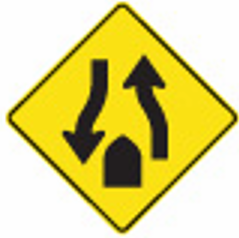
Divided highway ahead
Divided road ends, keep to the right
Narrow bridge
Road construction
This warning sign tells drivers that the divided road or median is ending ahead, and they must merge safely, keeping to the right. It prepares drivers for a transition to a two-way traffic road and requires extra caution during merging or lane positioning.
What does this sign mean?
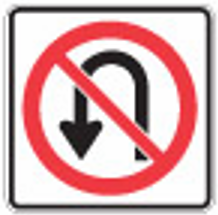
Slippery when wet
No right turn
No U-turn
No left turn
This sign indicates that U-turns are prohibited at this location for safety reasons. Such restrictions help prevent accidents in places with poor visibility, heavy traffic, or complex intersections where turning around could interfere with the safe flow of vehicles and increase the risk of collisions.
At a blocked intersection ahead, what should you do?
Proceed slowly into the intersection
Stay close to car ahead
Stop before entering and wait until traffic moves on
Honk to alert cars ahead
According to Ontario driving rules, you should never block an intersection. If traffic is backed up, stop before entering and wait for the traffic ahead to clear. This helps maintain smooth traffic flow and avoids obstructing the intersection, ensuring traffic moves freely from all directions.
Upon approaching a stop sign, a driver must:
Slow down, sound horn, then proceed
Slow down, proceed if clear
Stop, sound horn, then proceed
Stop, proceed when safe
In Ontario, a stop sign requires drivers to make a full and complete stop at the stop line, crosswalk, or intersection's edge, even if there’s no other traffic. Once stopped, proceed only when it is safe to do so, as required by the Highway Traffic Act.
What does a red light with a green arrow at an intersection mean?
Stop and wait for green signal before turning
Arrow is for pedestrians only
Stop, then go
Proceed with caution in the direction of the arrow
When a red signal light is displayed with a green arrow at an intersection, vehicles are allowed to proceed in the direction of the arrow but must do so with caution. The red signal means traffic in the opposite direction must stop, so drivers should ensure the way is clear.
What does this sign mean?
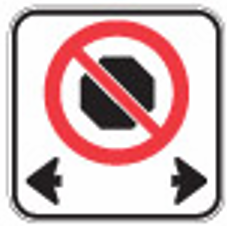
No entry
No stopping
Vehicles must stop
Arrows show stop exceptions
This regulatory sign informs drivers that stopping is strictly prohibited in the marked area, even temporarily. Vehicles must keep moving and are not allowed to halt for loading, unloading, or waiting, ensuring clear roadways for smooth traffic flow and preventing congestion or obstruction.
What does this sign signify?
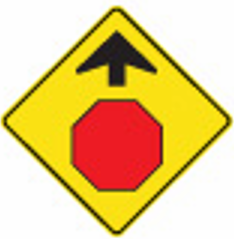
Yield ahead
Traffic light ahead
Stop sign ahead
Speed limit change ahead
This warning sign alerts drivers that they are approaching a stop sign around the corner or just over a hill, which may not be immediately visible.
What does this sign mean?
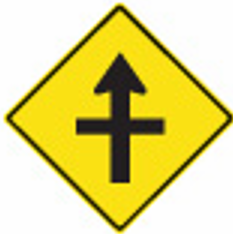
Narrow road
Hidden intersection
Railway crossing
Intersection ahead
This warning sign informs drivers that an intersection is approaching. Drivers should reduce speed, stay alert for crossing traffic, and be ready to stop or yield according to the traffic control at the intersection to avoid collisions and ensure safe passage through the junction.