Driving Test Alberta: Free Class 7 Learner’s Licence Practice 3
- The test is based on questions taken from the Alberta Driver’s Guide.
- You will be asked about safe driving practices, driving laws, and road signs.
- The test is a series of multiple choice questions.
Need the handbook?
Download the official Alberta Driver’s Guide PDF for free.
Reminder: To obtain your Alberta learner’s licence, you will need to pass a knowledge test.
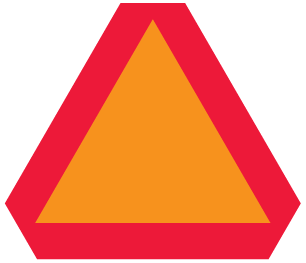
The following sign represents:
Yield the right-of-way to pedestrians and traffic.
Dangerous goods vehicle placard: flammable gas.
Slow moving vehicle.
Warning, Yield sign ahead.
A highly reflective orange triangle with a dark red border mounted on the rear of vehicles like tractors or construction gear that travel under 40 km/h.
When encountering a funeral procession that is crossing an intersection:
Flash the high beam headlights before proceeding.
Sound the horn before proceeding.
Yield the right-of-way and do not break through the procession.
Proceed through the funeral procession only when there is sufficient space between vehicles.
It is illegal to interrupt or drive through a formal funeral procession led by a sign, flashing lights, or an escort.
What are some tips to reduce the risk of fatigue while driving?
Avoid taking breaks.
Keep your vehicle at a high temperature.
Drive after drinking alcohol or taking medicine.
Be well rested and stop for a rest if feeling tired.
The only true cure for fatigue is sleep. Relying on loud music, open windows, or caffeine provides only a brief, false sense of alertness.
According to the law in Alberta, it is the driver’s responsibility to ensure that all passengers under what age are properly restrained in the vehicle?
16 years.
19 years.
17 years.
18 years.
The driver is legally responsible for ensuring any passenger under the age of 16 is properly buckled up using a seat belt or child safety seat.
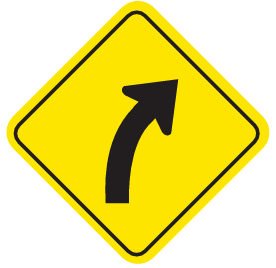
This sign indicates:
Winding road ahead.
Concealed intersection on the right.
Curve right.
Traffic entering from the right.
A sharp, right-bending arrow warning you of an upcoming, tight curve in the road so you can adjust your speed appropriately before you enter it.
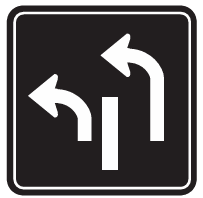
The following sign represents:
Sharp left curve in the road ahead.
Vehicles may turn left or go straight.
Dual left turn.
Left turns are prohibited.
A lane control sign showing two side-by-side arrows pointing left, indicating that vehicles in both designated lanes can turn left simultaneously.
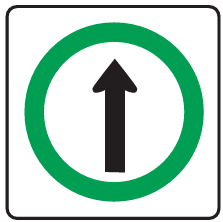
The following sign represents:
One-way street.
Go straight or turn left.
Left or right turn allowed.
Straight only.
A green circle enclosing a single arrow pointing straight up. This is a regulatory command—no left or right turns are permitted at this intersection.
This sign indicates:
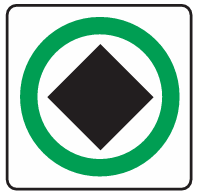
Route for slow moving vehicles.
Route for vehicles over 5000kg.
Dangerous goods route.
Reserved lane for buses.
A white regulatory circle with a green border and a black diamond symbol inside. It highlights mandatory routes for commercial vehicles hauling hazardous materials.
A deceleration lane is:
A lane where vehicles reduce speed when exiting a highway.
The lane immediately to the right of a solid yellow line on a highway.
A lane on hills for use by slower moving vehicles.
The right lane of a four-lane highway for use by slower moving vehicles.
You should not slow down on the main highway itself. Instead, signal, move into the deceleration lane, and slow down there.
A driver approaching a flashing red traffic light must:
Stop until the signal light turns green.
Stop and wait for the flashing green light.
Stop and proceed only when safe to do so.
Reduce speed and proceed with caution.
Treat a flashing red light exactly like a stop sign. Come to a complete stop, yield to cross traffic/pedestrians, and go when clear.
Who is responsible and legally obligated to report any medical condition, change in health, or physical disability that may affect a driver’s ability to drive?
The driver.
The driver’s doctor.
The driver’s employer.
The driver’s insurance company.
Legally, it is the sole responsibility of the driver to report any physical or medical changes to Alberta Transportation that could affect safe driving.
Unless otherwise permitted, what lane must a driver be in to turn left from a one-way road?
The lane to the right of centre.
The left lane nearest the left curb.
The lane closest to the right curb.
The centre lane.
Unless signs indicate otherwise, turning left from a one-way road requires you to enter and complete the turn using the leftmost lane.
When a driver is stopping behind another vehicle in traffic:
Maintain sufficient space as determined by the 2-second rule.
Allow sufficient space to move into another lane without reversing.
Remain a minimum of 10 metres from the vehicle ahead.
Keep back approximately 1 metre from the rear bumper of the vehicle ahead.
A good rule of thumb is that you should be able to see the rear tires of the vehicle ahead of you touching the pavement.
What do flashing lights from emergency vehicles indicate on the road?
Heavy traffic.
A problem ahead.
A road detours.
A closed lane.
Flashing lights warn you of an obstacle, crash, or emergency situation. Alberta law requires you to slow down to 60 km/h (or the posted limit if lower) when passing them.
If the vehicle’s right tires travel off the paved portion of the roadway:
Move the vehicle completely off the paved portion, then steer back onto the paved portion of the roadway.
Keep a firm grip on the steering wheel, ease off the gas pedal, and then gradually return to the paved portion of the roadway.
Accelerate slightly, then turn the steering wheel sharply to return to the paved portion of the roadway.
Apply the brakes firmly and counter-steer to return to the paved portion of the roadway.
Jerking the wheel or hitting the brakes/accelerator when your tires drop onto dirt or gravel will cause you to lose control or flip the vehicle. Stay calm, ease off the gas, stabilize the car, and steer gently back when safe.
What does this sign indicate?
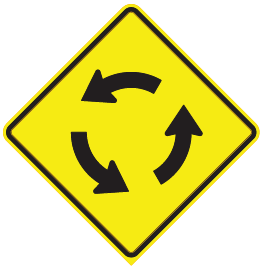
Railway crossing ahead.
Regulation sign ahead.
Recycling area ahead.
Roundabout ahead.
This warning sign features three arrows in a circular pattern, letting you know a traffic circle is coming up so you can slow down and prepare to yield to your left.
The following sign represents:
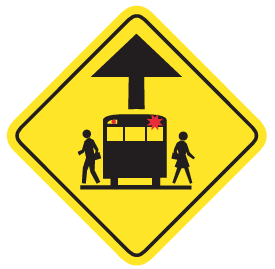
School zone ahead.
School bus stop ahead.
Pedestrian crossing ahead.
Playground zone ahead.
Features a school bus with passengers boarding. It warns you to watch out for stopped buses with flashing red lights and children crossing the road.
What does this sign mean?
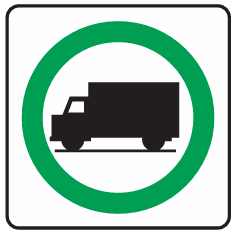
Only trucks are allowed.
Yield to trucks.
Trucks are allowed.
Parking area for trucks.
A black commercial truck silhouette inside a green circle, identifying standard designated truck routes for heavy transport vehicles.
What does this sign indicate?
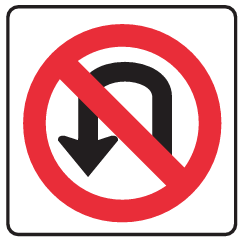
Do not enter.
U-turn is not allowed.
Go straight or turn right.
No roundabout ahead.
A bent "U" arrow inside a red circle with a slash through it, making it legally strictly forbidden to perform a U-turn at this location.
The following sign represents:
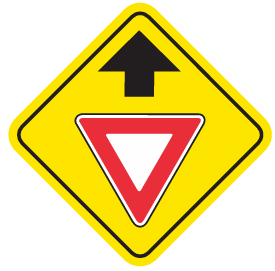
Slow moving vehicles ahead.
Do not enter.
Warning, traffic is approaching.
Yield ahead.
A diamond warning sign with a miniature red and white yield triangle inside it, giving you early notice to scan for cross-traffic and prepare to yield.
Is a driver allowed to exceed the speed limit when passing another vehicle?
Yes, but not more than 30 km/h over the speed limit.
No, it is never permitted.
Only when passing more than one vehicle at a time.
Yes, on primary highways only.
You are never allowed to exceed the posted speed limit, even when overtaking another vehicle.
What is the weight limit for children to use an approved booster seat?
20-30 pounds.
15-40 kilograms.
More than 18 kilograms or 40 pounds.
Less than 18 kilograms or 40 pounds.
Children must stay in a forward-facing car seat until they reach 18 kg (40 lbs). After that, they must use a booster seat until they are 9 years old, 145 cm (4'9") tall, or weigh 36 kg (80 lbs).
A slow moving vehicle sign must be displayed on the rear of any vehicle that normally travels at speeds less than:
50 km/h.
40 km/h.
30 km/h.
20 km/h.
An orange triangle with a red border must be placed on the back of any vehicle that travels at speeds less than 40 km/h.
When travelling in urban areas, drivers should scan the road approximately:
5 to 15 seconds ahead.
10 to 20 seconds ahead.
12 to 15 seconds ahead.
2 to 8 seconds ahead.
In urban areas, looking 12–15 seconds ahead (about 1 to 1.5 blocks) gives you enough time to anticipate changing lights, pedestrians, and turning vehicles.
Why should you be cautious while driving on bridges and overpasses?
The tend to form slippery patches easily.
They are poorly lit.
They are typically narrow.
They have more traffic.
Because cold air circulates both above and underneath bridges, they lose heat quickly and form dangerous "black ice" much sooner than regular roads.
What does this sign mean?
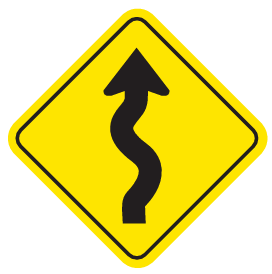
Slippery when wet.
Lane changing permitted.
Weave zone ahead.
Winding road ahead.
A squiggly, snake-like arrow indicating a series of three or more consecutive curves ahead. You should reduce your speed before entering the first bend.
In the Basic License Driver’s Handbook, “nighttime” is defined as the period of time:
Between 7:00pm and 7:00am.
Beginning at sunset and ending at the following sunrise.
Beginning 1 hour after sunset and ending 1 hour before the following sunrise.
Beginning 1 hour before sunset and ending 1 hour after the following sunrise.
This specific timeframe dictates when your headlights must be on, and it applies directly to regulations for graduated drivers (GDL) or certain vehicle types.
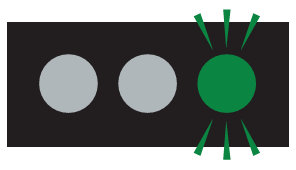
When approaching an intersection where the green light is flashing?
Do not yield to pedestrians.
No turn permitted.
Stop and proceed.
Permitted to go through, turn left or turn right without stopping.
In Alberta, this is a pedestrian-activated light. You can proceed normally without stopping, but stay alert for pedestrians who may have hit the crosswalk button to trigger a change.
The following sign represents:
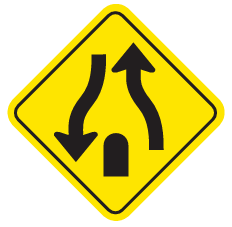
Lane ends or narrows ahead.
Divided highway ends ahead.
Divided highway begins ahead.
Narrow road ahead.
Shows two arrows curving around a median block at the bottom. It warns you that the physical divider separating oncoming lanes is ending, and you will soon be on a two-way road.
When parallel parking, the vehicle’s wheels closest to the curb must be within what maximum distance?
50 cm from the curb.
60 cm from the curb.
40 cm from the curb.
20 cm from the curb.
When parked parallel, your tires must be within a maximum distance of 50 cm (approx. 20 inches) from the curb and aligned straight.