Driving Test Ontario: Free G1 Knowledge Test Practice 2
- The test is based on questions taken from the MTO (Ontario) Driver’s Handbook.
- You will be asked about Safe and Responsible Driving and Traffic Signs and Lights.
- The test is a series of multiple choice questions.
Need the handbook?
Download the official Ontario Driver’s Handbook PDF for free.
Reminder: To obtain your Ontario G driver’s licence, you will need to pass a knowledge driving test.
If a traffic signal changes while the pedestrian is still in the street, which of the following has the right of way?
Motorists making turns.
The pedestrian.
Motorist coming from his right.
Motorist coming from his left.
In Ontario, if a pedestrian is still in the street when the traffic signal changes, the pedestrian has the right of way. This applies regardless of the signal changing to green for vehicles. Drivers must always yield to pedestrians who are crossing the street, even if the signal has changed for vehicles.
What does this road sign indicate?
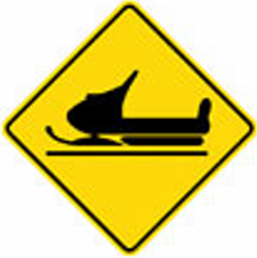
Snowmobile repair shop ahead.
Snowmobile parking.
Snowmobiles cross this road.
Snowmobiles not allowed.
This sign alerts drivers that snowmobiles may cross the road in the area. It's important to be cautious and look out for snowmobiles crossing the road, particularly during winter months when snowmobiling is common. Always slow down and yield the right of way to snowmobiles when necessary.
As a level G2 driver, your blood alcohol level must not be over:
0.08%.
0.05%.
0.02%.
0.00%.
In Ontario, there is a zero-tolerance alcohol policy for novice drivers, including G2 drivers who are under the age of 22. This means that novice drivers must have a Blood Alcohol Concentration (BAC) of 0.00%. Even the smallest trace of alcohol in their system is not allowed.
What does a red circle with a diagonal line through it indicate?
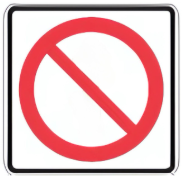
Prohibited action.
Do not enter unless local traffic.
Traffic circle ahead.
Do not enter the roadway.
A red circle with a diagonal line through it is a prohibitory symbol. It means that whatever is shown inside the circle is not allowed or is prohibited. For example, if a right-turn arrow is shown inside the circle with a line through it, it means “No right turn.” These are common regulatory signs used to indicate restrictions.
What does the flashing light on a school zone sign indicate?
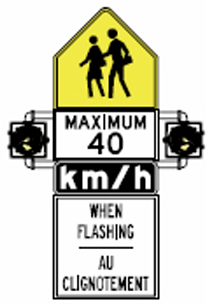
It is a warning sign.
Watch for cross guard only.
During school hours when the lights are flashing, follow the speed limit shown.
Speed limit is 4 km/hr always.
The flashing lights on a school zone sign are there to alert drivers that they are approaching a school area, and they indicate that the posted speed limit is in effect. This typically applies during school hours, when children may be walking near the road or waiting for buses. When the lights are flashing, drivers must reduce their speed to the limit shown, ensuring the safety of students.
What does a blue road sign with a white "H" symbol indicate?
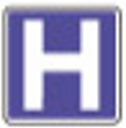
Hospital.
Housing.
Hills.
Horse racing.
In Ontario, road signs with a blue background and white symbols are informational or guide signs. A sign with a white "H" on a blue background is used to indicate the location of a hospital nearby. These signs help drivers identify essential services, especially in emergencies.
Unless otherwise posted, the maximum speed limit in cities, towns, villages and built up area is:
50 km/hr.
40 km/hr.
30 km/hr.
60 km/hr.
In Ontario, unless otherwise posted, the maximum speed limit within cities, towns, villages, and built-up areas is 50 km/h. This is a standard speed limit to ensure safety in populated areas, as it allows drivers to react to unexpected obstacles, pedestrians, or changes in traffic conditions more easily.
This rule applies unless there are specific signs indicating different speed limits. For example, highways or roads outside built-up areas may have higher speed limits.
What documents may a police officer require a motor vehicle driver to produce?
Liability insurance card.
Motor vehicle ownership.
A valid driver’s license.
All of the above.
A police officer may require a driver to produce all of the following documents: liability insurance card to prove coverage, motor vehicle ownership to verify legal possession, and a valid driver’s license to confirm the driver is authorized to operate the vehicle.
What does the following sign indicate?
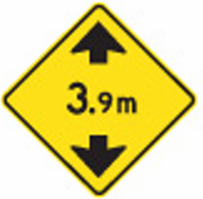
Bumpy road ahead.
Watch for falling rocks.
School zone ahead.
Sign shows maximum truck clearance height.
This sign typically appears on roadways or bridges where there is a restriction for vehicles with a certain height. It indicates the maximum clearance height for trucks, so drivers can avoid getting their vehicle stuck or damaged. If the vehicle exceeds this height, it could potentially collide with the structure, so it's crucial for truck drivers to pay attention to such signs.
What does the following sign mean?
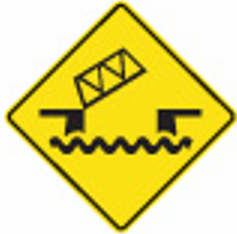
Bridge ahead lifts or swings.
Airport.
Hotel.
Narrow road ahead.
This sign warns that the bridge ahead may lift or swing open to let boats pass. Drivers must be prepared to stop when the bridge is in operation. Always obey warning signals and barriers.
When on streets designed for two-way traffic, you hear the siren of an emergency vehicle, what does the law require you to do?
Pull to the right as far as possible and stop.
Signal the driver to pass.
Speed up and get out of the way.
Continue on the same speed.
When you hear the siren of an emergency vehicle (such as an ambulance, fire truck, or police vehicle) on a street with two-way traffic, the law in Ontario requires you to pull over to the right as far as possible and stop. This allows the emergency vehicle to pass safely and quickly. It is essential to stop and remain stationary until the emergency vehicle has passed, ensuring that it can reach its destination without obstruction.
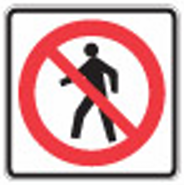
What does this road sign mean?
No bicycles.
No pedestrians allowed.
No children allowed.
Pedestrians allowed.
This regulatory road sign features a red circle with a line through a walking person, indicating that pedestrians are not permitted beyond this point. It is used in areas where pedestrian access is unsafe or prohibited, such as on certain highways, construction zones, or private roads. This ensures the safety of both drivers and pedestrians. It does not relate to bicycles, children, or animals, which would have their own specific signs.
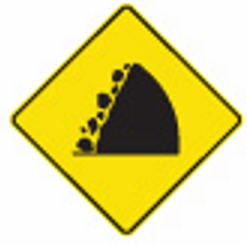
What does this road sign mean?
No trucks allowed.
Steep hill ahead.
No passing allowed.
Watch for falling rocks.
This sign warns drivers that rocks may fall onto the road. Be careful and watch the road ahead. It’s a warning, not a rule or restriction.
Overdriving your headlights at night is dangerous because:
You are driving too fast.
Your headlights are too bright.
You cannot stop the distance that you can see.
It is not good for your car battery.
Overdriving your headlights means driving at a speed that is too fast for the distance you can see in front of you. At night, your headlights only illuminate a limited distance ahead. If you drive too fast, you may not have enough time to react to hazards within that illuminated area, which increases the risk of an accident. It’s important to drive at a speed that allows you to stop safely within the distance your headlights can illuminate.
What does this road sign indicate?
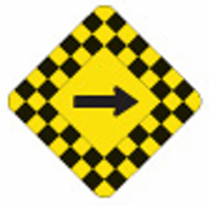
Winding road ahead.
Caution, Sharp turn ahead.
Danger, Road ends.
Keep left.
This warning sign alerts drivers to an upcoming sharp turn in the road. It's often a yellow diamond-shaped sign with a black arrow sharply turning in one direction (left or right). The sign is placed well in advance of the turn to give drivers time to reduce speed and navigate safely.
As a level one G1 driver, you must be accompanied by a class G or higher licensed driver, who has more than the following driving experience:
Three years.
Four years.
Two years.
Six years.
In Ontario, as a G1 driver, you are required to be accompanied by a fully licensed driver who has at least four years of driving experience. This experience can include time spent holding a G2 license.
While travelling on a highway, the driver of a vehicle is not permitted to carry in a trailer:
Firearms.
Flammable material.
People.
Pets.
In Ontario, it is illegal to carry people in a trailer while traveling on a highway. Trailers are typically intended for cargo, and carrying passengers in a trailer is dangerous and not allowed under Ontario's traffic laws. Firearms, flammable materials, and pets may have specific regulations for transportation but are not explicitly banned from being carried in a trailer. However, transporting people in a trailer is strictly prohibited for safety reasons.
Which of the following has the right of way over all the others at an intersection when the signal light is green?
Pedestrians crossing against the light.
Pedestrians crossing with the light.
Vehicles turning right.
Vehicles turning left.
In Ontario, when the signal light is green, pedestrians crossing with the light have the right of way. This means that vehicles must yield to pedestrians who are crossing at a designated crosswalk with the green pedestrian signal.
What does this road sign mean?
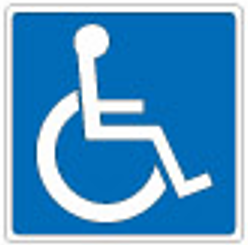
Winding road ahead.
No standing.
No parking.
By wheelchair only or disabled person parking.
This sign means parking is only for vehicles with a valid accessible (disabled) parking permit. Unauthorized parking may result in fines or towing.
You are driving up to an intersection where there is no signal light or police officer, a pedestrian is in the crosswalk on your side of the street. You should:
Increase speed and take the right-of-way.
Slow down and drive with increased caution.
Sound horn to warn the pedestrian.
Stop and yield right-of-way to the pedestrian.
In Ontario, drivers must yield the right-of-way to pedestrians in a crosswalk, even if there are no traffic lights or police officers present. This is clearly stated in the Ontario Driver’s Handbook and is part of the province's pedestrian safety laws.